
Luke
Summary of the Gospel of Luke
Dedication
Luke 1:1-4: Luke dedicates his gospel account to Theophilus, expressing his intent to write an accurate, orderly, and thorough account of the events fulfilled among them. This is intended to provide certainty about the things Theophilus has been taught.
Birth Narratives
Luke 1:5-2:52: Luke provides a detailed account of the birth of John the Baptist and Jesus Christ. These narratives include angelic announcements to Zechariah and Mary, prophecies about the children's futures, the miraculous circumstances surrounding their births, and Jesus's early life.
Ministry of John the Baptist
Luke 3:1-4:13: John the Baptist's ministry of repentance and baptism is recounted, followed by the baptism of Jesus, the genealogy of Jesus, and His temptation in the wilderness. The baptism signifies the beginning of Jesus' ministry, and the genealogy emphasizes His humanity and divine lineage.
Jesus' Ministry in Galilee
Luke 4:14-9:50: During His ministry in Galilee, Jesus teaches in synagogues, performs various miracles, and calls His disciples. The miracles not only show His divine power but also His compassion and concern for people's physical and spiritual well-being.
Journey to Jerusalem Begins
Luke 9:51-62: Jesus sets out resolutely for Jerusalem, where His suffering and death await Him. When a Samaritan village refuses to receive Him, He rebukes the disciples’ desire for revenge. He teaches that following Him requires commitment, even when it means leaving familiar comforts and responsibilities behind.
Mission, the Good Samaritan, and Mary and Martha
Luke 10:1-42: Jesus sends His followers ahead in pairs to heal the sick and announce God’s kingdom. The Good Samaritan illustrates love for one’s neighbor through practical mercy. In Martha’s home, Jesus commends Mary for listening to His teaching instead of allowing the demands of serving to distract her.
Prayer and True Obedience
Luke 11:1-54: Jesus teaches His disciples to pray, encourages persistence, and speaks of the Father’s willingness to give the Holy Spirit. He answers accusations about His power over demons and calls people to hear and obey God’s word. He also exposes the hypocrisy of religious leaders who neglect justice and love.
Trusting God and Being Ready
Luke 12:1-59: Jesus warns against hypocrisy and greed, using the rich fool’s story to show that possessions cannot secure one’s life. He urges His followers to trust the Father’s care, seek His kingdom, and be generous. His teaching about watchful servants emphasizes readiness and responsible stewardship.
Repentance, Healing, and God’s Kingdom
Luke 13:1-35: Jesus calls people to repent and uses the barren fig tree to illustrate the need for fruitfulness. He heals a woman who has been bent over for eighteen years, despite objections about the Sabbath. The mustard seed and yeast illustrate God’s kingdom, while the narrow door warns against presuming on salvation.
Humility and the Cost of Discipleship
Luke 14:1-35: Jesus heals a man on the Sabbath and teaches His hearers to choose humility rather than places of honor. He urges hospitality toward those who cannot repay them. The great banquet describes rejected invitations, and His teaching about carrying the cross calls followers to consider the cost of discipleship.
The Lost Sheep, Lost Coin, and Prodigal Son
Luke 15:1-32: When religious leaders complain that Jesus welcomes sinners, He tells three parables about what was lost being found. A shepherd seeks a sheep, a woman searches for a coin, and a father welcomes his repentant son. These stories reveal heaven’s joy over repentance and challenge the older brother’s resentment.
Faithful Stewardship and Eternal Priorities
Luke 16:1-31: Through the dishonest manager’s story, Jesus teaches His disciples to use resources wisely and be faithful in small matters. He warns that no one can serve both God and wealth. The rich man and Lazarus illustrate the seriousness of ignoring those in need and refusing to heed God’s word.
Forgiveness, Faith, and the Coming Kingdom
Luke 17:1-37: Jesus teaches His disciples to forgive repeatedly and serve without demanding praise. He cleanses ten men with leprosy, but only one, a Samaritan, returns to thank Him. He explains that God’s kingdom is already among them and warns that the Son of Man’s future revelation will require readiness.
Persistent Prayer and Humble Faith
Luke 18:1-43: The persistent widow encourages perseverance in prayer, while the Pharisee and tax collector show the difference between self-righteousness and humble repentance. Jesus welcomes children, challenges a wealthy ruler, and again predicts His death and resurrection. Near Jericho, He restores a blind beggar’s sight.
Zacchaeus and the Entry into Jerusalem
Luke 19:1-44: Jesus visits Zacchaeus, whose response includes generosity and restitution, and declares that He came to seek and save the lost. The parable of the minas teaches responsibility while awaiting the king’s return. Jesus then enters Jerusalem to His disciples’ praise and weeps over the city’s failure to recognize its visitation.
Teaching in Jerusalem
Luke 19:45-21:38: Jesus teaches in the temple in Jerusalem and confronts the religious leaders, challenging their understanding and practices. He also provides prophetic teachings about the future, including the destruction of Jerusalem and signs of the end times.
Jesus' Passion
Luke 22:1-23:56: Luke recounts the events of Jesus' passion, including the Last Supper, His betrayal by Judas, His arrest, trial, crucifixion, death, and burial. Throughout these events, Jesus' humility, compassion, and submission to the Father's will are highlighted.
Resurrection and Ascension
Luke 24:1-53: The women find the tomb empty, and two heavenly messengers announce that Jesus has risen. On the road to Emmaus, He explains how the Scriptures point to His suffering and glory; the two disciples recognize Him when He breaks bread.
Jesus then appears to the gathered disciples, shows them His hands and feet, and eats before them. He opens their understanding of Scripture, commissions them to proclaim repentance and forgiveness, and tells them to await power from on high. Near Bethany, He blesses them and ascends into heaven.
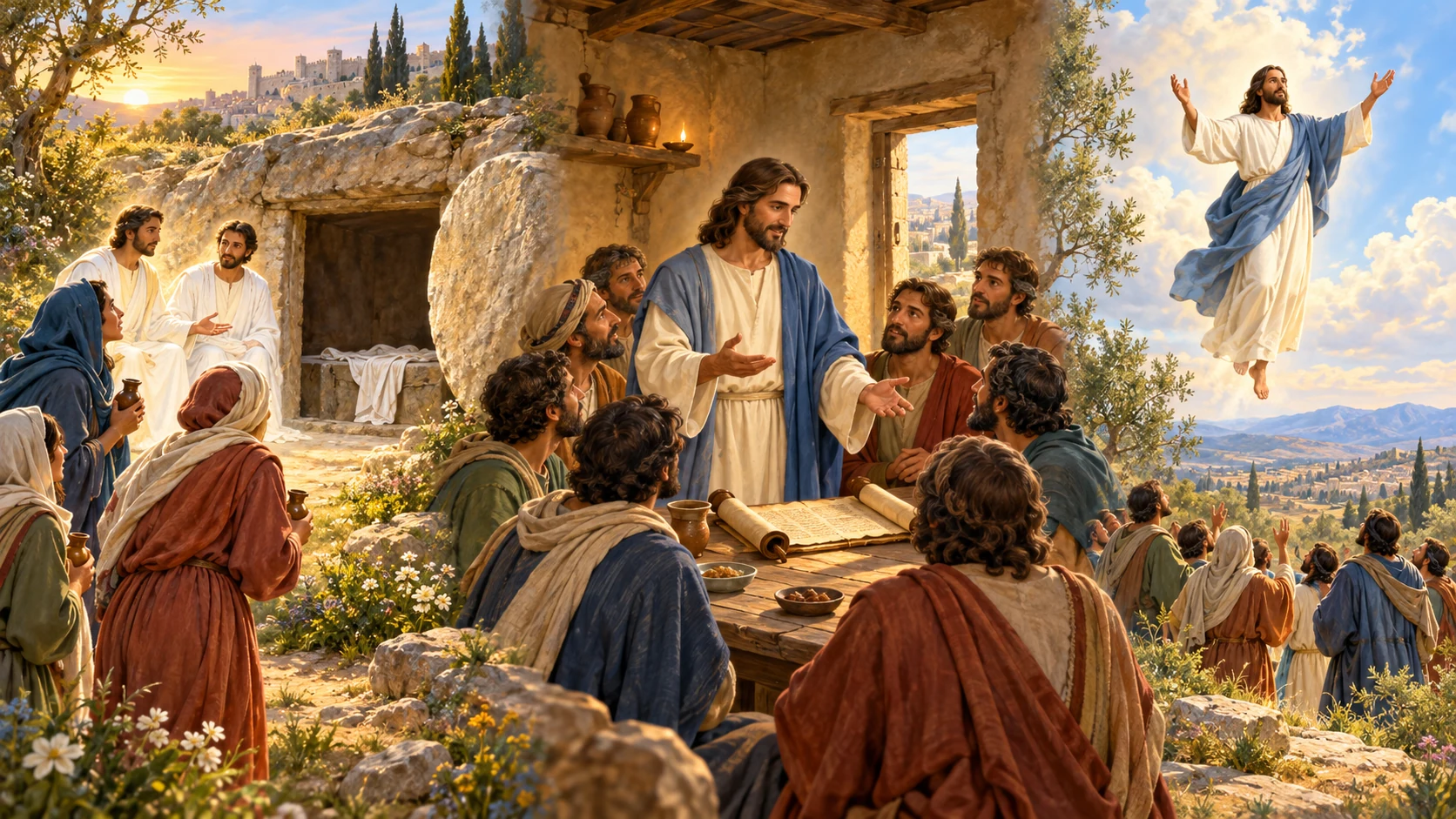
This montage shows the empty tomb and Jesus speaking to His disciples then His ascension into Heaven — Luke 24.
Miracles in the Gospel of Luke
Driving out an Impure Spirit
Luke 4:31-37: Jesus commands an impure spirit to leave a man in the synagogue in Capernaum. The demon obeys, causing amazement among the people.
Healing of Simon's Mother-in-Law
Luke 4:38-39: Jesus heals Simon Peter's mother-in-law who was suffering from a high fever, by standing over her and re- buking the fever. She recovers immediately and begins to serve them.
Healing Many Sick & Oppressed at Evening
Luke 4:40-41: At sunset, people brought many who were sick or oppressed by demons to Jesus. He healed the sick and cast out the demons, commanding them not to speak because they knew He was the Christ.
Healing a Leper
Luke 5:12-16: Jesus heals a man full of leprosy by touching him and willing him to be clean. Jesus instructs the man to show himself to the priest and make an offering according to Moses' law.
Healing a Paralytic
Luke 5:17-26: Jesus heals a paralytic man who was low- ered through the roof by his friends. Jesus forgives his sins, which causes a con- troversy among the Pharisees and teachers of the law, and then heals his physical condition, proving His authority to forgive sins.
Healing a Man with a Withered Hand
Luke 6:6-11: Jesus heals a man with a withered right hand on the Sabbath in the synagogue, confronting the Pharisees' understanding of the Sabbath. This miracle leads to increased hostility from the religious leaders.
Healing a Centurion's Servant
Luke 7:1-10: A Roman centurion's highly val- ued servant is healed by Jesus from a distance, after the centurion displays re- markable faith in Jesus' authority and power to heal.
Raising of the Widow's Son at Nain
Luke 7:11-17: Jesus resurrects a widow's only son during the funeral procession at Nain, displaying His compassion and power over death.
Calming the Storm
Luke 8:22-25: During a storm on the Sea of Galilee, Jesus calms the wind and the waves, demonstrating His power over nature.
Healing the Gerasene Demoniac
Luke 8:26-39: Jesus heals a man pos- sessed by many demons in the region of the Gerasenes. The demons are sent into a herd of pigs which rush down a steep bank into a lake and drown.
Healing a Woman with a Hemorrhage
Luke 8:43-48: A woman who has been bleeding for twelve years touches the edge of Jesus' cloak and is healed instantly. Jesus publicly acknowledges her healing, attributing it to her faith.
Raising of Jairus' Daughter
Luke 8:49-56: Jesus brings Jairus' twelve- year-old daughter back to life, demonstrating His power over death.
Feeding of the Five Thousand
Luke 9:10-17: Jesus miraculously feeds about five thousand men, besides women and children, with five loaves and two fish, demonstrating His divine provision.
Healing a Boy with an Evil Spirit
Luke 9:37-43: Jesus heals a boy who is afflicted by a demon that his disciples could not drive out. This healing ex- hibits Jesus' supreme authority over evil spirits.
Healing of the Ten Lepers
Luke 17:11-19: Jesus heals ten lepers, but only one, a Samaritan, returns to thank Him. Jesus emphasizes the impor- tance of gratitude and faith.
Healing of a Blind Beggar
Luke 18:35-43: Jesus restores the sight of a blind beggar near Jericho. The man's persistent faith leads to his healing, and he follows Jesus, glorifying God.
Jesus' Resurrection
Luke 24:1-12: On the first day of the week, women visiting Jesus' tomb find it empty. Two men in dazzling clothing inform them that Jesus has risen, as He said.